
Quick Answer: The AC Infinity Controller 69 Pro is the best VPD controller for most home growers. It monitors temperature, humidity, and VPD in real time, automatically adjusts fan speed and light intensity, manages up to four devices, and connects to the AC Infinity app for remote access and historical data. For larger setups managing eight or more devices, step up to the 69 Pro+. For a budget entry into VPD automation, the VIVOSUN GrowHub E42A does the job at roughly half the price.
Most growers obsess over lights and nutrients while ignoring the variable that quietly limits every other input they give their plants: VPD. Get VPD right and your plants absorb nutrients more efficiently, transpire at the optimal rate, and resist disease. Get it wrong and you can be feeding perfectly, lighting perfectly, and still watch yields plateau for a reason that never shows up in a deficiency chart.
A VPD controller removes the manual work of monitoring temperature and humidity together and adjusting equipment in response. Instead of checking your tent three times a day and tweaking fan speed by hand, the controller reads conditions continuously and makes micro-adjustments automatically. This guide covers what VPD actually is, why it matters more than temperature or humidity alone, and which controllers are worth buying in 2026.
Disclosure: WeedMania420 participates in the Amazon Associates Program. Purchases through our links may earn us a small commission at no extra cost to you. We only recommend products we have genuinely researched and believe in.
Table of Contents
What Is VPD and Why Does It Matter More Than RH Alone?
VPD stands for Vapour Pressure Deficit. It measures the difference between the amount of moisture the air currently holds and the maximum moisture it could hold at that temperature. In practical terms, VPD tells you how hard the air is “pulling” moisture from your plant’s leaves.
Relative humidity alone is an incomplete measurement. A healthy VPD range of 0.8 to 1.2 kPa during vegetative growth supports optimal nutrient uptake by maintaining the right transpiration rate. RH of 60% means something very different at 65°F than at 85°F because warmer air holds more moisture, changing the actual vapour pressure deficit despite an identical humidity reading.
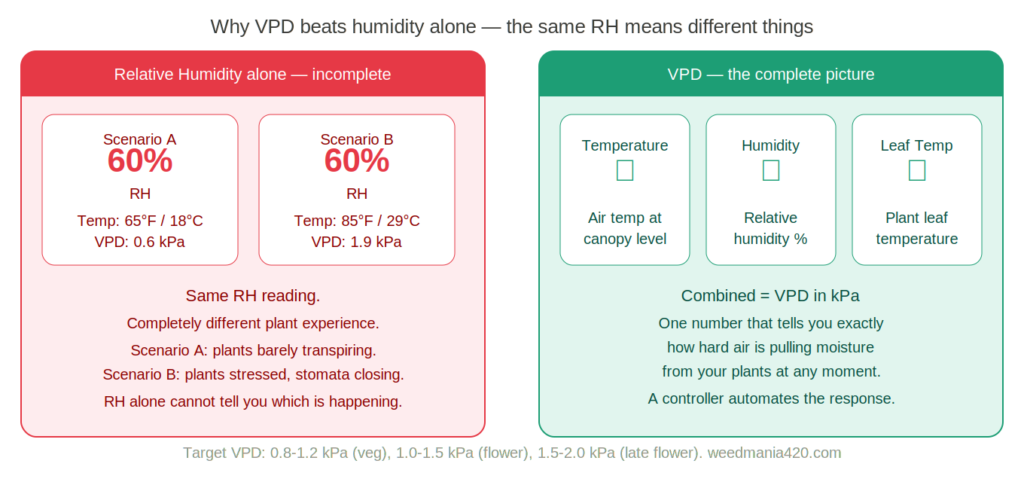
VPD triggers account for ambient temperature, relative humidity, and the plant’s leaf temperature, which optimises nutrient uptake more precisely than relying on temperature and humidity alone. That three-variable measurement is why VPD controllers produce noticeably better results than simple temperature or humidity triggers set independently.
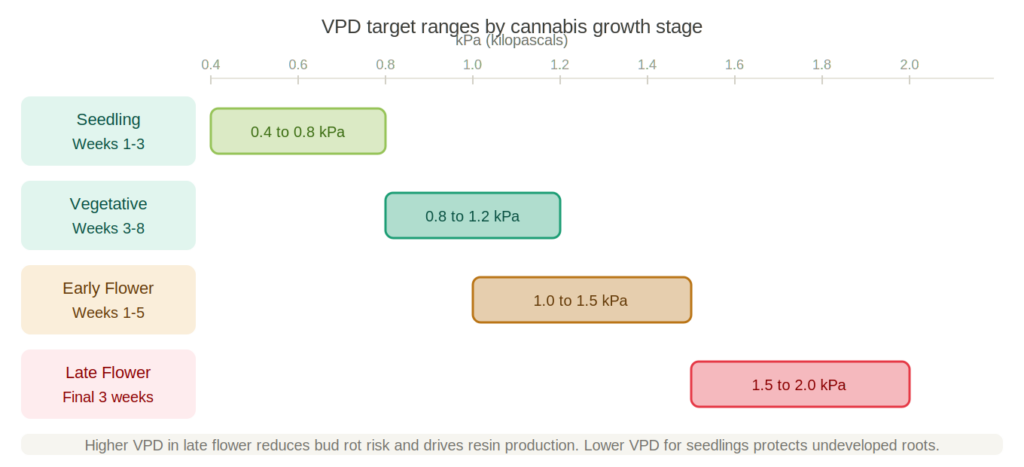
Target VPD by growth stage:
- Seedling: 0.4 to 0.8 kPa. Seedlings absorb most moisture through leaves, so low VPD reduces stress on undeveloped roots.
- Vegetative: 0.8 to 1.2 kPa. Plants transpire actively, driving nutrient uptake through the roots.
- Early flower: 1.0 to 1.5 kPa. Increasing VPD drives resin production and tightens bud structure.
- Late flower: 1.5 to 2.0 kPa. High VPD and lower humidity reduce bud rot risk significantly in dense canopies.
These targets pair directly with the temperature and humidity guidance in the 2×2 grow tent setup guide. Where that guide gives you the target ranges, a VPD controller hits them automatically.
What to Look for in a VPD Controller
VPD-specific triggers. Some controllers market themselves as VPD-capable but only allow temperature and humidity triggers separately. A true VPD controller reads the combined vapour pressure deficit and adjusts equipment based on that calculated value, not two independent variables.
Number of controllable devices. Entry-level controllers manage two to four devices. Mid-range manage four to eight. At four devices, you can typically run an inline fan, a grow light, a humidifier, and one additional device. If you need more simultaneous control, step up to an eight-port model.
EC motor compatibility. EC (electronically commutated) motors allow true variable speed control from 0 to 100%, compared to traditional AC motors which only switch on or off. A VPD controller paired with a non-EC fan can only turn the fan on or off at a fixed speed, eliminating the fine-grained response that makes VPD automation valuable. AC Infinity CLOUDLINE fans and most modern inline fans use EC motors. Confirm compatibility before buying.
App and data logging. Remote monitoring via app and historical data charting are meaningful features for serious growers. Seeing a week of VPD data as a chart reveals patterns that daily manual readings never would, particularly the difference in VPD during lights-on versus lights-off periods.
PID algorithm vs simple triggers. The AC Infinity Controller AI+ uses PID (Proportional-Integral-Derivative) algorithms to adjust fan speeds and light intensities gradually rather than in binary on/off steps. This prevents the sharp climate fluctuations that simple on/off triggers produce, which can stress plants by rapidly cycling between extremes.
The Best VPD Controllers for Grow Tents in 2026
1. AC Infinity Controller 69 Pro — Best Overall
Price: ~$90-110 | Devices: Up to 4 | VPD control: Yes | App: Yes (iOS + Android)
The AC Infinity Controller 69 Pro supports up to four connected devices, with dynamic programs that automatically adjust fan speeds and light intensity based on real-time VPD, temperature, and humidity readings. Growers can set minimum baseline levels so devices maintain steady operation, only increasing output when environmental triggers are activated — a practical feature that prevents over-ventilation during stable periods.
The core appeal lies in its ability to execute AI-powered control of your grow room based on VPD, temperature, and humidity metrics, moving beyond simple on/off logic by using PID algorithms to adjust fan speeds and light intensities gradually. The result is a tent environment that responds smoothly to changes rather than lurching between states.
The device features dual-mode connectivity, supporting both Bluetooth and 2.4GHz WiFi, allowing the controller to sync with the AC Infinity app. Through the app, you can view live data from your grow space anywhere in the world, adjust fan speed, change light cycles, or turn off a heater remotely, with push notifications alerting you immediately if your grow tent gets too hot or if humidity drops below set parameters.
The Controller 69 Pro works exclusively with AC Infinity’s UIS connector system, which means your inline fan needs to be an AC Infinity CLOUDLINE model for full VPD-speed integration. It can control non-UIS devices via a standard outlet trigger, but those devices only get on/off control rather than variable speed. If you are already running an AC Infinity fan from reading the ventilation calculator guide, this controller slots in without any additional purchases.
Some users report occasional issues, and firmware or app updates have been known to reset saved schedules, requiring reconfiguration. Back up your settings after any firmware update.
Best for: Growers with one to four AC Infinity devices who want full VPD automation with app access and PID control.
Pros:
- True VPD-based PID control with gradual fan and light adjustment
- Dual Bluetooth and WiFi connectivity
- Historical data logging and CSV export via app
- Controls up to four devices on independent programmes
- Minimum baseline speed settings prevent over-ventilation
Cons:
- Full variable-speed control requires AC Infinity UIS-compatible devices
- Firmware updates have occasionally reset saved schedules
- App requires 2.4GHz WiFi, not 5GHz
👉 Check current price on Amazon.
2. AC Infinity Controller 69 Pro+ — Best for Larger Grows
Price: ~$130-150 | Devices: Up to 8 | VPD control: Yes | App: Yes (iOS + Android)
The 69 Pro+ is the 69 Pro scaled up. The Controller 69 Pro+ manages up to eight devices, with options for shared or independent programming for each device. For growers running multiple tents, a 4×4 with supplemental humidifier, dehumidifier, heater, and multiple fans, the eight-port capacity removes the compromise of prioritising which devices get smart control.
Everything from the 69 Pro applies here: PID-based VPD control, full app integration, historical data logging, and UIS compatibility. The practical upgrade beyond device count is the ability to run truly independent programmes across all eight ports simultaneously, which matters in multi-stage setups where veg and flower zones need different VPD targets.
Best for: Multi-device setups, two-tent operations, or any grow requiring simultaneous control of more than four pieces of equipment.
Pros:
- Eight independent device ports with separate programming
- Same PID VPD algorithm as the 69 Pro
- Full app integration with remote monitoring
- Scalable to large home and commercial operations
Cons:
- Higher cost than the 69 Pro for growers who do not need eight ports
- Same app and firmware caveats as the 69 Pro
👉 Check current price on Amazon.
3. VIVOSUN GrowHub E42A — Best Budget VPD Controller
Price: ~$50-65 | Devices: Up to 4 | VPD control: Yes | App: Yes (VIVOSUN app)
The VIVOSUN GrowHub E42A controller monitors and adjusts lighting, temperature, humidity, and VPD levels inside the grow tent. The clear display provides an at-a-glance view of device status, and it allows remote control via the VIVOSUN app, offering custom growing recipes, advanced settings such as timers, cycles, and temperature/humidity triggers.
The GrowHub E42A costs roughly half what the AC Infinity 69 Pro costs and delivers solid VPD automation for growers who are not yet invested in the AC Infinity ecosystem. It integrates most naturally with VIVOSUN’s own fan and light range, but can control third-party devices via standard outlet triggers.
The GrowHub sensors track temperature and humidity but lack the ability to measure CO2, soil moisture, PPFD, and other key data. Some users report issues with unreliable WiFi connections and slow customer support responses. These are real-world limitations to factor in, particularly the WiFi reliability issue if remote monitoring is a priority for you.
For a grower who wants to step into VPD control without the AC Infinity price premium, the E42A is a functional and honest starting point. When you outgrow it, the upgrade path to the Controller 69 Pro is straightforward.
Best for: Budget-conscious growers new to VPD automation, or those already in the VIVOSUN ecosystem.
Pros:
- Roughly half the price of the AC Infinity 69 Pro
- VPD monitoring and automation via app
- Custom growing recipes by growth stage
- Compatible with VIVOSUN’s inline fans and lights
Cons:
- WiFi reliability issues reported by some users
- Sensor only tracks temperature and humidity, no CO2 or PPFD
- Third-party device integration is limited to on/off outlet control
- Customer support response times are slower than AC Infinity
👉 Check current price on Amazon.
4. Spider Farmer GGS Pro Controller — Best for Spider Farmer Ecosystem Users
Price: ~$70-90 | Devices: Up to 4 | VPD control: Yes | App: Yes
The Spider Farmer GGS series features control hubs including the GGS Pro Controller, and can pair with the SensorPro to track temperature, humidity, VPD, and PPFD. Each control centre supports the expansion of additional sensors to monitor key environmental factors such as temperature, humidity, VPD, PPFD, DLI, soil conditions, and CO2 levels, offering full control over the grow room climate.
The PPFD and DLI tracking is what differentiates the GGS Pro from the competition at this price point. Most VPD controllers measure temperature and humidity and calculate VPD from those two variables. The GGS Pro can additionally track actual light intensity at canopy level, which feeds into more precise environmental programming. If you are running Spider Farmer lights and want a single ecosystem controller, the GGS Pro is the natural choice.
The GGS Pro integrates seamlessly with Spider Farmer’s own grow lights and climate devices. Cross-brand compatibility follows the same pattern as other controllers: full variable control within the Spider Farmer ecosystem, on/off outlet control for third-party devices.
Best for: Growers already using Spider Farmer lights who want a matched controller with PPFD monitoring capability.
Pros:
- PPFD and DLI tracking alongside VPD
- Designed to integrate with Spider Farmer lights for full variable control
- Expandable sensor options including CO2 and soil conditions
- Competitive price versus AC Infinity at similar device count
Cons:
- Full smart integration limited to Spider Farmer compatible devices
- Less community support documentation than AC Infinity
👉 Check current price on Amazon.
5. TrolMaster Tent-X — Best for Professional Setups
Price: ~$180-250 | Devices: Expandable via modules | VPD control: Yes | App: Yes
The TrolMaster Tent-X Grow Tent System is more expensive and complex than entry-level controllers, making it more suitable for professional growers and generally not recommended for hobbyists. While it can integrate third-party devices via expansion modules, setup is more involved compared to plug-and-play systems like VIVOSUN or AC Infinity.
The Tent-X earns its premium through genuine third-party device integration. Where other controllers are limited to their own brand’s ecosystem for variable-speed control, the TrolMaster uses expansion modules to control third-party fans, humidifiers, CO2 generators, and HVAC equipment at variable levels. For a grower running a mixed-brand professional setup, this flexibility is worth the higher price and steeper learning curve.
The control precision is also stronger at the professional end: the Tent-X logs data continuously, sends alerts, and allows multi-zone control across different growing spaces from a single interface.
Best for: Professional or semi-commercial growers, multi-room operations, and anyone running mixed-brand equipment who needs genuine third-party variable control.
Pros:
- Genuine third-party device integration via expansion modules
- Scalable across multiple rooms and zones
- Comprehensive data logging and alerting
- Designed for professional cultivation environments
Cons:
- Significantly more expensive than home-grow options
- Setup is more complex than plug-and-play systems
- Overkill for single-tent home grows
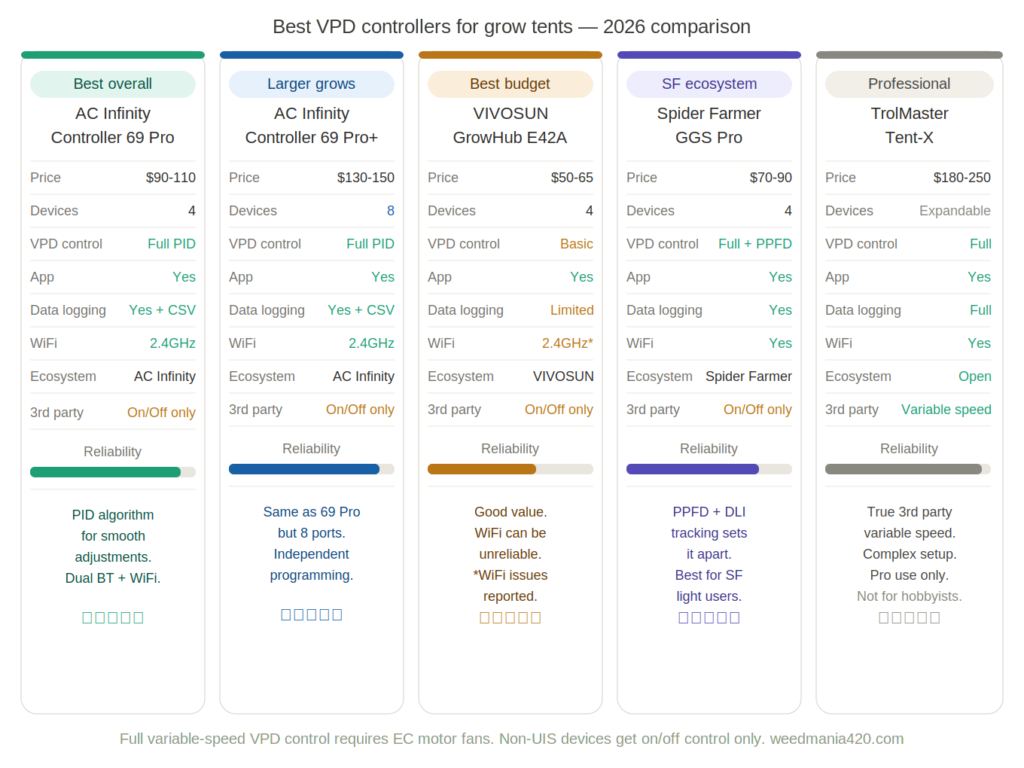
Quick Comparison
| Controller | Price | Devices | VPD Control | App | Best For |
| AC Infinity 69 Pro | ~$90-110 | 4 | Full PID | Yes | Most growers |
| AC Infinity 69 Pro+ | ~$130-150 | 8 | Full PID | Yes | Larger grows |
| VIVOSUN GrowHub E42A | ~$50-65 | 4 | Basic | Yes | Budget buyers |
| Spider Farmer GGS Pro | ~$70-90 | 4 | Full + PPFD | Yes | SF ecosystem |
| TrolMaster Tent-X | ~$180-250 | Expandable | Full | Yes | Professional |
Do You Actually Need a VPD Controller?
Honest answer: no, not at first. A basic thermometer/hygrometer and a VPD chart are enough to manually dial in your environment across the first one or two grows. Many experienced growers run excellent results with no automation at all, adjusting fan speed by hand once or twice a day based on manual readings.
A VPD controller earns its keep when you want your tent running precisely during lights-off while you sleep, when you are managing multiple devices simultaneously, or when you want to stop spending 20 minutes a day on manual adjustments. The time and yield improvements justify the cost for anyone growing consistently across multiple cycles.
If you are buying your first thermometer/hygrometer and have not yet nailed your baseline environment, start there. The Inkbird IBS-TH2 or the Govee Bluetooth sensor gives you temperature, humidity, and app logging for under $20, which is enough to understand your environment before investing in automated control. See the grow tent environment targets by stage to understand what numbers you are targeting.
Setting Up Your VPD Controller: Key Steps
Getting a VPD controller running correctly takes about 30 minutes on first setup. Work through these in order.
Place the sensor at canopy level. Every controller ships with a temperature/humidity probe. Where that probe sits determines what the controller responds to. Hanging it at the top of the tent near the light reads a different environment than the plant canopy experiences. Mount the probe at the height of the canopy, shaded from direct light, to get accurate readings.
Set minimum device speeds before enabling VPD triggers. On the AC Infinity controllers, set a minimum fan speed of 30 to 40% before enabling VPD-based automation. This prevents the controller from completely stopping the fan during favourable conditions, which would eliminate the negative pressure keeping your carbon filter effective.
Programme by growth stage. Set your VPD targets to match the stage your plants are in: 0.8 to 1.2 kPa for veg, 1.0 to 1.5 kPa for early flower, 1.5 to 2.0 kPa for late flower. Most controllers allow you to pre-programme stage transitions so the targets update automatically on a schedule.
Check for light leaks after mounting the sensor. Adding a sensor probe cable through a tent port creates a new potential gap. Run the darkness test after setup to confirm no light enters through the probe port or any newly adjusted ventilation connection.
Log a baseline week before relying on automation. Let the controller log conditions for 5 to 7 days before switching to full automatic mode. Review the historical data chart to understand how your tent actually behaves across a 24-hour light/dark cycle before trusting the automation to maintain it.
VPD and Your Nutrient Programme
VPD directly affects how efficiently plants absorb the nutrients you feed them. When VPD is too low, transpiration slows and nutrient solution moves through the plant slowly. When VPD is too high, plants close their stomata to conserve moisture and uptake drops sharply.
This connection between VPD and nutrient absorption is why experienced growers who dial in VPD often report better results from the same nutrients and feeding schedule they have always used. The nutrients were always there. The absorption rate was the bottleneck. The autoflower nutrient guide covers the feeding schedule side of this equation — a VPD controller handles the environmental side.
Cannabis grown at optimal VPD shows measurably better nutrient uptake efficiency, faster vegetative development, and denser bud structure compared to plants grown in poorly controlled environments. The combination of the right feeding programme and right VPD targets is one of the clearest paths to improving yield without changing a single input.
FAQ
What is a good VPD for cannabis in flower? 1.0 to 1.5 kPa in early flower, increasing to 1.5 to 2.0 kPa in late flower. Higher VPD in late flower reduces bud rot risk and encourages resin production.
Does a VPD controller work with any fan? Full variable-speed VPD control only works with EC motor fans. Most VPD controllers can switch standard outlet devices on or off based on VPD triggers, but genuine 0-100% speed modulation requires an EC motor fan. Confirm your fan is compatible before buying.
Can I use a VPD controller without the app? Yes. The AC Infinity Controller 69 Pro has onboard controls and a display for direct programming without the app. The app adds remote access, historical charts, and push notifications but is not required for basic VPD automation.
What is the difference between the AC Infinity 69 Pro and 69 Pro+? Device count. The 69 Pro manages four devices; the 69 Pro+ manages eight. The VPD control algorithm, app features, and sensor specifications are identical between the two.
Do I need a VPD controller for autoflowers? Not strictly. Autoflowers have a compressed lifecycle and are generally more tolerant of environmental variation than photoperiods. Manual monitoring with a quality thermometer/hygrometer is sufficient for most auto grows. A controller adds precision and convenience but is not a prerequisite for good autoflower results.